
M3U8 vs MP4: Why Streaming Platforms Don't Just Use MP4
M3U8 and MP4 are often compared, but they're not really competing — they serve completely different purposes. MP4 is a complete video file format; M3U8 is a playlist format that controls streaming playback. When you watch a video online that starts immediately and adjusts quality based on your connection, M3U8 is almost certainly what's driving it — not a single MP4 file being downloaded.
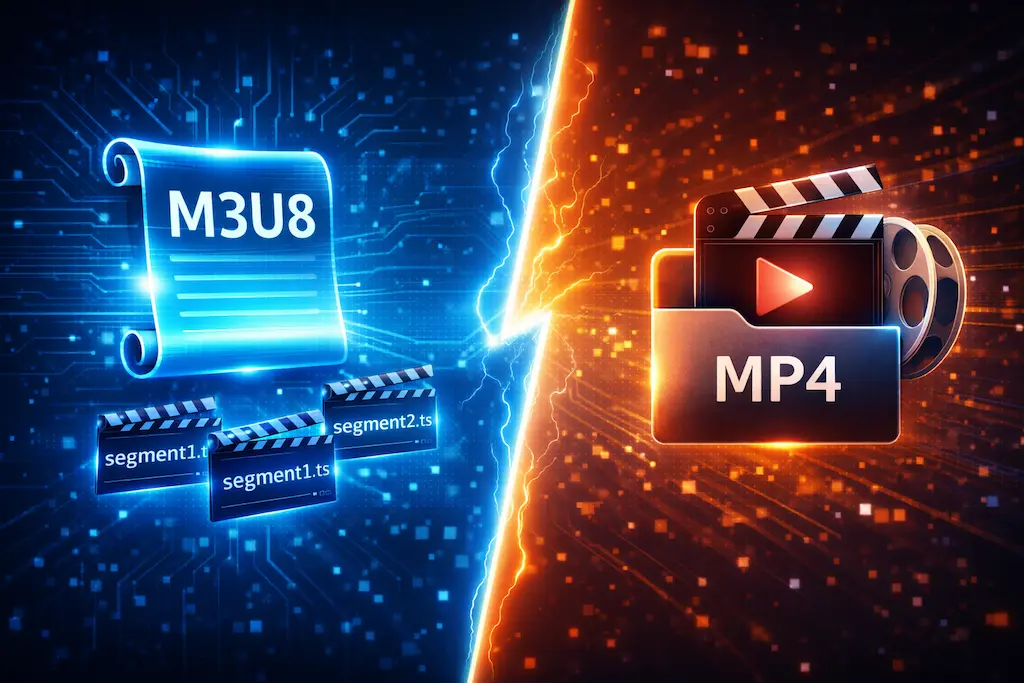
The Fundamental Difference Between M3U8 and MP4
The first step is understanding their roles in the system.
MP4 Is "The Video Itself"
MP4 is a container format that directly contains audio and video data. As long as the file exists, a player can play it from start to finish. Playback behavior is largely independent of network conditions.
M3U8 Is "Playback Instructions"
M3U8 contains no video data at all. It's a plain text file that tells the player where to fetch segments, in what order to play them, and when to switch quality levels. The actual video data is distributed across many small segments.
If you're still unsure about M3U8's role: 👉 What is M3U8? Ultimate Guide
Why Do Streaming Platforms Prefer M3U8?
Large-scale streaming platforms have priorities that are very different from someone downloading a video file.
Time to First Frame
With MP4 playback, the player typically needs to download a portion of the file before it can begin. The larger the file, the more noticeable the wait.
M3U8 splits the video into short segments. The player only needs the first segment to start playback — making the experience feel more immediate.
Tolerance for Network Conditions
A single MP4 file will stall if the network slows down.
M3U8 can switch between segments of different quality levels. When the network is unstable, the player automatically fetches lower-quality segments to keep playback uninterrupted.
This behavior is implemented through the HLS protocol. For a deeper look: 👉 M3U8 & HLS Protocol Explained
Which to Choose for Different Use Cases?
The choice between M3U8 and MP4 depends heavily on how the video will be used.
When M3U8 Makes Sense
- Online streaming platforms
- Live broadcasts
- Long-duration content
- Scenarios requiring quality adaptation to network conditions
These use cases prioritize continuous, stable playback over file integrity.
When MP4 Makes Sense
- Local playback
- File storage and archiving
- Offline viewing
- Sharing or backup
If a video is delivered as "one file per request," MP4 is almost always the most straightforward choice.
The Difference in Viewing Experience
From a user's perspective, the experience differs noticeably.
Watching via M3U8
The user typically doesn't perceive a "file" at all — the video simply starts playing immediately. Quality may shift, but playback remains relatively smooth.
Watching via MP4
MP4 playback is more predictable, but waiting and buffering become more noticeable with large files or poor network conditions.
To experience M3U8 playback behavior yourself: 👉 How to Play M3U8: Complete Guide
Why M3U8 Isn't Suited for Download Storage
Many people ask: if M3U8 can stream video, why not just save it as a single file?
The Structure Isn't Designed for Storage
M3U8 splits video into a large number of segments for playback flexibility, not convenience of storage. This structure is optimized for real-time delivery, not for packaging into a single portable file.
Access Restrictions and Security
Many stream sources embed access restrictions into M3U8 — time-limited tokens, Referer checks, IP binding — so that content can only be played under specific conditions, not downloaded freely.
This is precisely why platforms choose streaming over direct MP4 downloads.
Troubleshooting: How Failures Differ
When playback fails, the diagnostic approach differs between the two formats.
MP4 Playback Failures
Usually caused by a corrupted file or an unsupported codec in the player.
M3U8 Playback Failures
More often the result of source restrictions, access permissions, or playback environment issues. For specific error codes: 👉 Common M3U8 Playback Errors & Fixes
FAQ
Can M3U8 be converted to MP4?
Yes. If you don't want to install FFmpeg, this site's Browser-Based HLS Downloader can merge a public stream into MP4 without any installation. For technical details: 👉 M3U8 to MP4 Conversion Guide
Why don't platforms just offer MP4 downloads?
Because streaming provides more flexibility in bandwidth management, playback experience, and content access control.
Do regular users need to understand this difference?
Not for everyday viewing — but when playback fails or you're choosing a tool, understanding the distinction helps you diagnose the problem correctly.
Ready to test your M3U8 stream?
🚀 Try the M3U8 Online Player